
Digital Sugar Testing Saccharimeters
The Rudolph Research Analytical Autopol 880 and Autopol 880T best selling saccharimeters
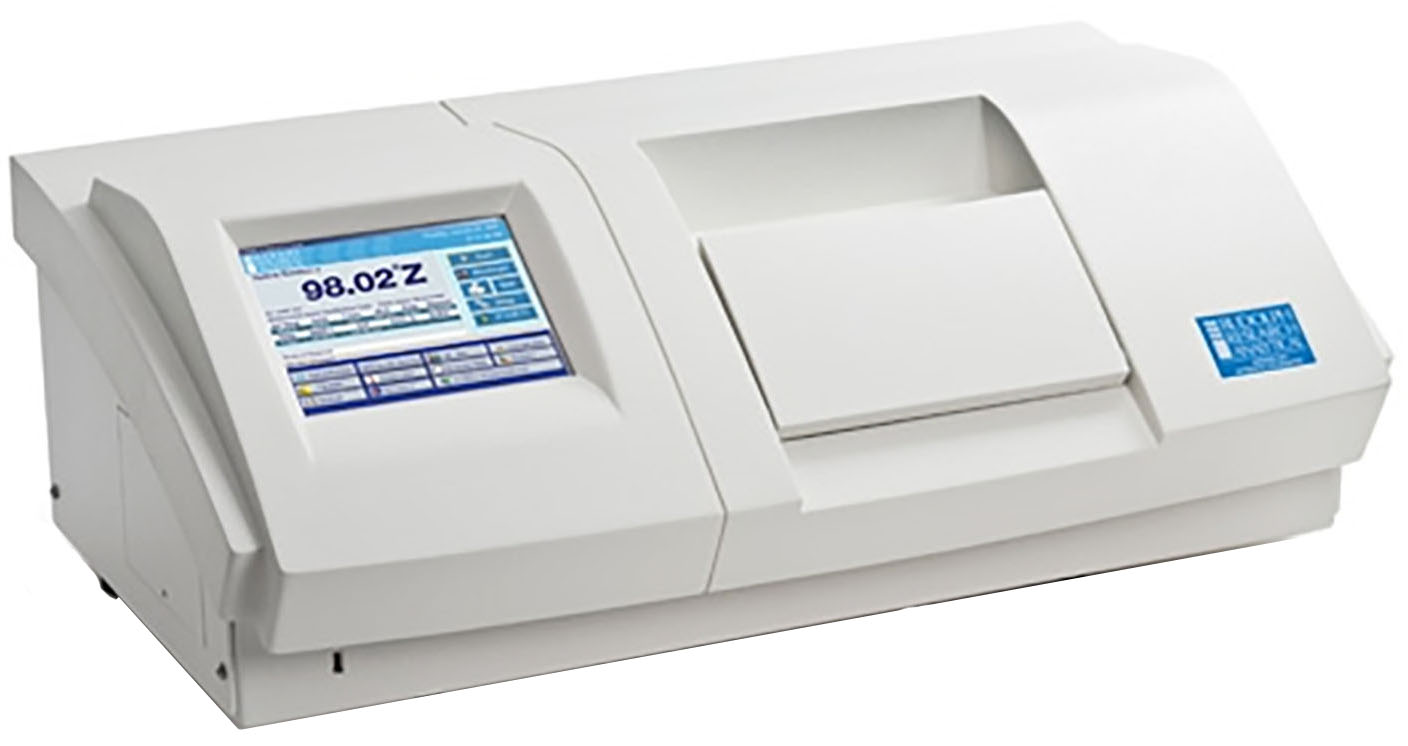

Best selling Saccharimeters
2 wavelengths
Automatic calibration
Dilution and cell length correction
Sugar Analysis
These saccharimeters are used by 98% of all US sugar mills and 100% of all US customs labs. It has 0.01 accuracy and is available in both 2 and 4 wavelength versions. Capable of measuring at both 589 nm and 880 nm, the 880 nm ICUMSA Approved near infrared wavelength allows measurement of dark sugar factory juices, while the purity mode provides simultaneous measurement and display of Purity, Brix and POL.
Dual Wavelengths
The most important feature of the Autopol 880 and 880T is the ability to measure at two wavelengths: 589 nm and 880 nm (NIR). Select 589 nm for conventional analysis using chemicals or lead clarifiers, or select 880 nm for polarimetric sugar measurements in the near infrared (NIR).
880 nm is above the absorption level of most dark sugar factory solutions allowing measurement of filtered but non-lead clarified juices. The dark sample measurement bar gets darker in proportion to the darkness of the sample being measured. When the bar is completely dark the instrument has reached its measurement limit.
Try Before You Buy
The Autopol 880 and 880T are available for a short term trial.
Request Information

Dilution and Cell Length Correction
Whether your sugar analysis requires a 25mm, 50mm, 100 mm or 200 mm cell, whether you use 1/2 normal (13g/100ml), 1/4 normal (6.5g/100ml) or full weight sugar solutions, the AUTOPOL® 589, 880, 880 Plus and 880T saccharimeters provide the correct multiplier to display the reading as if the sample were prepared as a 1 normal solution in a 200 mm optical pathlength cell.

Automatic Saccharimeter Calibration
Calibrating the Autop[ol is quick and simple. First, place a quartz control plate calibration standard on the optical rails and enter the quartz plate value in the appropriate window. Then enter the temperature to correct the measurement to either the ICUMSA standard temperature of 20°C or the Tropical reference temperature of 27.5°C. Finally press Save and the calibration is complete.

Automatic Temperature Correction
Utilizing the temperature probe located in the measurement compartment, temperature correction to 20ºC, 27.5ºC or other user defined temperature is performed easily and automatically by the Autopol 880 and Autopol 880T.. The probe can be inserted into all 14 style, 40T style, 41T style and 33 style measurement cells.
The Autopol displays the temperature source and type of correction. Utilizing factory programmed temperature coefficients the Autopol can make the following types of temperature corrections:
- A 30° C sucrose sample can be measured by the temperature probe and corrected to 20°C or 27.5°C or a customer defined temperature
- A 29°C sucrose sample in a Type 14 center fill glass cell can be measured by the temperature probe inside the saccharimeter sample chamber and corrected to 20°C
- A Quartz Plate measured at 25°C by the chamber temperature probe and then automatically corrected to 20°C


Temperature Probe Insertion Options
The temperature probe in the sample compartment can be inserted into the polarimeter cell.

Automation and Continuous Sampling
Cells are available in 25mm, 50mm, 100mm and 200mm optical path lengths with fittings for any application.

Pour in Sampling
Stainless steel cells are available in 50mm, 100mm and 200mm optical path lengths.

Optics
No matter which Autopol saccharimeter you choose it will feature the same high quality optics. While other manufacturers use Polaroid plastic dichroic sheet polarizers, Rudolph Research employ Glan Thompson Calcite polarizers in all its models. High quality polarizing prisms are important because they are two of the most critical optical components in a saccharimeter. Polaroid polarizers are made of a polymeric plastic where the molecules are stretches and oriented in a specific direction so as to linearly polarize light. These types of plastic sheet polarizers are cheap, vulnerable to heat and warping, deteriorate from moisture and have greater light absorption than Calcite polarizers.
Lifetime Guarantee
In many cases the plastic polarizers must be replaced in as little as 3 years whereas Rudolph guarantees its prisms over the life of the Saccharimeter. Glan Thompson calcite polarizers are comprised of a carbon crystalline structure similar to diamond and have excellent light transmission characteristics. The quality of these prisms is such that they are guaranteed over the life of the saccharimeter.

TempTrol
The patented TempTrol technology eliminates the need for a water bath, allowing push-button temperature control of the 100mm cell, 200mm cell or quartz control plate. Set the temperature, push “measure” and walk away. The Autopol will heat or cool to a predefined temperature and then provide you with the result in one easy step. The TempTrol™ system will accurately control your sample temperature to within ±0.2°C. This is particularly important for laboratory work when measuring pharmaceutical grade sugars.


Purity Software Definitions
The Autopol 880 and 880T always display Purity as if it were reading a 1 normal solution as defined in SPS-1: 3.1 The “normal sugar solution” is defined as 26.0160 g of pure sucrose weighed in vacuo and dissolved in water at 20.00°C to a final volume to 100.000 cm3. This corresponds to 26.000 g weighed in air under normal conditions (1013 mbar, 20°C, 50% relative humidity) and dissolved in water to a final volume of 100.000 cm3. Therefore, Rudolph displays:
% Sucrose = °Z reading corrected for dilution
Example: a 1/4 normal wt. solution reading 13.70°Z will read (4 x 13.70°Z) 54.80% Sucrose.
%RDS-OP = Refractometer dissolved solids or Brix prior to dilution
Example: a 3:1 dilution having a refractometer Brix reading of 14.30 would read 42.90 %RDS-OP (14.30 Brix x 3)
%PURITY = %Sucrose x 100 x apparent density polynomial, %RDS-OP
Also available the Autopol IZ and IIZ, the Autopol 589 and the 880 Plus and 880T Plus.
Download Literature


Specifications
Optical Wavelengths: Standard – 589nm, 880nm Optional – 587nm, 882 nm
Wavelength Selection: Selectable: 2 standard, 4 optional
Measuring Mode: °Z (°ISS), Optical Rotation or User Defined Scale
Measuring Range: ±89.9° Arc Optical Rotation, ± 259°Z (ISS)
Resolution: 0.001° Arc Optical Rotation, 0.01°Z (ISS)
Reproducibility: 0.001° Arc Optical Rotation, 0.01°Z (ISS)
Accuracy: 0.01°Z (ISS)
Measuring Scale: °Z (ISS)
Prism: Glan Thompson Calcite
Temperature Control: Standard by external Water Bath Optional 880T,TempTrol electronic heating and cooling 18°C – 35°C
Temperature Correction: 18°C – 40°C
TempTrol™ Accuracy: Temperature accuracy determined by external water bath
Temperature Probe Range: 10° – 40°C
Temperature Probe Accuracy: ±0.1°C
Measurement Time: 12°/sec
Light Source: Tungsten-halogen 6V, 20W, Average 2,000 hr. life
Optional Light Source: LED 20-30 mA 100,000 hr. avg
Sample Chamber: Accepts sample tubes up to 200mm
Data Storage: 32 GB SSD
Communication Interface: 1 x Serial, 1 x VGA, 1 x HDMI, 2 x Cat 5, 4 x USB ports
Calibration: Automatic calibration via touchscreen
Purity Software: Standard
Connection to Refractometer: Standard
Display: 800 x 600 pixel resolution with 400 nits of brightness
User Interface: Touchscreen
Automatic Sensitivity Control: Measures samples with transmittance as low as 0.01% (up to O.D. 4.0)
Input Power: 100 – 240 Volts, 50/60Hz
Dimensions: 762 mm W x 431.8 mm H x 279.4 mm D
Weight: 39 kg